
Table of Contents
- Roles and access
- What are absence types?
- Create custom absence type
- Rename or delete absence type
- Enable or disable absence types
- Absence type settings
- Display as — how absence is shown to others
- Allow graded absence — how partial days are counted
- FAQ
Roles and access
| Access | Role |
|---|---|
| Configure absence types | System role: Absence → Absence management |
What are absence types?
Absence types define the different categories of absence available in Huma, such as vacation or sick leave. Huma comes with seven built-in absence types: Vacation, Self-certification, Sick leave, Paid time off, Unpaid time off, Sick child and Parental leave.
You cannot rename or delete these built-in types, but you can enable or disable each one and configure their settings. Administrators can also create custom absence types, based on one of the seven built-in types. See "Create a custom absence type" below.
Base types
Every absence type in Huma, whether one of the seven built-in types or a custom type you create, belongs to one of seven base types: Vacation, Self-certification, Sick leave, Paid time off, Unpaid time off, Sick child, Parental leave.
The base type determines how absence of that type is calculated and grouped in reports. For example, a custom type based on Sick leave will be counted as sick leave in the sick leave report, even though it has its own name in Huma.
💡 When you create a custom absence type, its symbol and description start out copied from its base type. You can change most settings afterwards, but the base type itself cannot be changed later.
🔗 Read more about how absence works in Huma.
Create a custom absence type
- Go to the Absence module
- Navigate to "Settings"
- Click "Create absence type"
- Select a base type to build your custom type on — this determines how it's calculated and grouped in reports
- Fill in a name, icon and description for your custom type
- Click "Create"
💡 The name must be unique among your organisation's custom absence types.
💡 After creating a custom type, you can configure it further, such as who can register absence of this type and how it's shown to others.
⚠️ A new custom absence type isn't ready for use right away. If its base type has a default policy, Huma copies it automatically, quota, time period and transfer settings included. If the base type has no default policy, the new type starts with no policy at all. Either way, no employees are assigned yet, so make sure a policy exists and employees are assigned before anyone can register absence of this type.
⚠️ The export code is not copied from the base type. Until you set one manually on the new type's policy, the absence details export will show a blank export code for it, and payroll integrations may reject absence of this type.
💡 If your organisation has active integrations that sync absence, you must map the new custom absence type in each integration's settings before absence of this type can sync. It does not automatically use its base type's mapping — an unmapped custom absence type will be rejected when it tries to sync. Huma shows a reminder on the type's settings page if a mapping is missing.
🔗 Read more in Create absence policies and Assign people to absence policies.
Rename or delete a custom absence type
Huma's seven built-in absence types cannot be renamed or deleted. Custom absence types can be renamed at any time, and deleted if they haven't been used yet.
To rename a custom absence type:
- Go to the Absence module
- Navigate to "Settings"
- Scroll down to the custom absence type and click on it
- Click the name field and enter a new name
- Click "Save"
To delete a custom absence type:
- Go to the Absence module
- Navigate to "Settings"
- Scroll down to the custom absence type and click on it
- Click "Delete absence type"
- Type "Delete" to confirm
💡 A custom absence type can only be deleted if no absence has ever been registered for it. If it has been used, you'll see the option to disable it instead, this keeps its history intact but stops new registrations.
⚠️ Deleting a custom absence type is permanent and cannot be undone.
🔗 If your organisation syncs absence with a payroll or accounting system, remember to update the type mapping if you rename or delete a custom absence type.
Enable or disable absence types
You can control which absence types employees are able to register. Disabled absence types are not visible to employees.
- Go to the Absence module
- Navigate to "Settings"
- Scroll down to "Absence types and policies"
- Toggle each absence type on or off
Absence type settings
Each absence type has a set of settings that control how it works. You can configure the following, and all of the settings are find by:
- Go to the Absence module
- Navigate to the "Settings" tab
- Scroll down to the absence type you want to edit and click on it
- "Edit absence type"
- Make your changes and click "Save"
| Setting | Description |
|---|---|
| Symbol | An emoji and colour used to represent the absence type in the calendar and lists |
| Description | A short description shown to employees during registration. Use it to clarify when or how the type should be used. Keep it short. |
| Display as | Controls how absence is shown to colleagues. See the section below for a detailed explanation. 🔗 Read more here. |
| Require approval | If enabled, absence registrations of this type require approval from a user with absence management access. |
| Allow graded absence | Allows employees to register partial absence, e.g. 50% sick leave. See the section below for a detailed explanation. 🔗 Read more here. |
| Allow partial days | Allows employees to register partial first and/or last days of an absence period. |
| Require end date | If enabled, employees must enter an end date when registering. If disabled, absence can be registered without an end date and runs until manually stopped. |
| Require notes | If enabled, employees must provide a note when registering absence of this type. |
| Include option for work related cause | Adds an option for the employee to flag whether the absence is work related. |
| Export code | A code included in the detailed export. Should match your external absence or payroll system's codes. |
| Enable absence follow-up process | Activates the structured absence follow-up process. Huma currently supports Norwegian and Swedish sick leave legislation. The follow-up process is based on the employee's public holiday calendar. |
| Responsible for follow-up | Who is responsible for managing the follow-up process — either the employee's supervisor, or a fallback if no supervisor is assigned. |
💡 When you turn off "Require approval" for an absence type, all existing pending absence entries of that type will automatically be approved.
Display as — how absence is shown to others
The "Display as" setting controls how colleagues without absence admin access see registered absence of this type.
| Option | What colleagues see |
|---|---|
| Public | The absence is visible in full — name, type and dates |
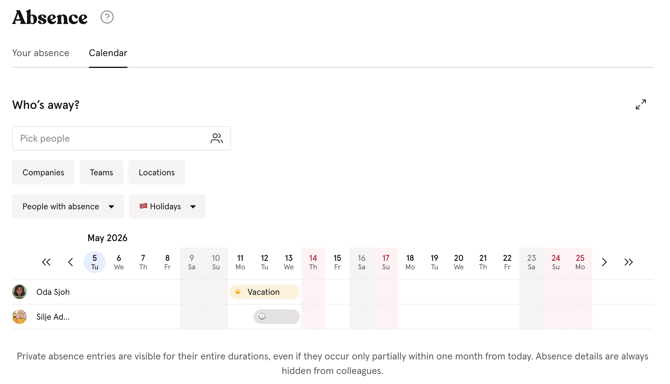
| Away (private) | The absence is shown as "Away" only, without details — and only within one month of the current date |
| Hidden | Visible only to absence administrators and the employee |
💡 Important rules regardless of display setting:
- Absence administrators always see all absence in full
- Unapproved absence is never visible to colleagues, regardless of display setting
- Private absence is only visible within one month of the current date. If any part of the absence falls within that window, the entire absence is shown as "Away"
- Absence without an end date is treated as still active and will remain visible as "Away" until an end date is set
Allow graded absence — how partial days are counted
When "Allow graded absence" is enabled, employees can register a percentage when registering absence, for example 50% sick leave. You can choose how partial registrations are counted in balances and reports:
| Option | How it works | Example (50% sick leave, Jan 1-2) |
|---|---|---|
| Count as full days in Huma | Days registered with less than 100% still count as full days | 2 days registered, counts as 2 days |
| Count as partial days in Huma | Days registered with less than 100% count as partial days | 2 days registered, counts as 1 day |
FAQ
Can colleagues see that an employee is on sick leave?
It depends on the "Display as" setting for sick leave. If it is set to "Away (private)", colleagues will only see that the person is away, but not why. If it is set to "Public", the absence type is visible to everyone.
Can managers see why an employee is away?
Yes. Users with absence management access, either through a system role or a user role with absence access, always see the full details of absence regardless of the "Display as" setting.
Can colleagues see how long an employee has been sick?
If sick leave is set to "Away (private)", colleagues can only see the absence within one month of the current date. This means they cannot see the full duration of a long-term sick leave period.
If absence is set to Hidden, does it disappear from the absence calendar completely?
No. Absence set to "Hidden" is still fully visible to absence administrators in the absence calendar and in all reports. Only colleagues without absence management access will not see it. Nothing is ever truly hidden from administrators.
Can we hide parental leave from colleagues?
Yes. Set parental leave to "Away (private)" or "Hidden". This is particularly relevant if you want to avoid revealing a pregnancy before the employee is ready to share the news.
There is a time limit on what colleagues can see in the absence calendar — how does this work?
Private absence (set to "Away (private)") is only visible to colleagues within one month of the current date. If any part of the absence falls within that one-month window, the entire absence is shown as "Away" for that period. Outside of that window, it is not visible. This means colleagues cannot see past or future private absence beyond one month, but administrators always have full visibility regardless of this limit.
Yes. Self-certification policies can use restrictions to limit how many entries employees can register, how long each entry can be, and how many days they can use within the time period. Presets are available for Norway (3 × 4 and IA agreement), Sweden and Finland. Huma stops registrations that go over the limits — also when an administrator registers on behalf of an employee.
💡 The limits only apply if restrictions are set up on the policy. A policy that uses "Limit number of days" doesn't stop registrations.
🔗 Read more about self-certification restrictions.
Can I create my own absence types?
Yes. Go to Absence → Settings and click "Create absence type." Your custom type is based on one of the seven built-in base types, which determines how it's calculated and grouped in reports.
Can I delete a custom absence type?
Yes, but only if it has never been used, meaning no absence has been registered for it. If it has been used, you can disable it instead, which keeps historical data intact.
Can I rename or delete Huma's built-in absence types?
No. The seven built-in absence types can only be enabled, disabled or reconfigured. Only custom absence types can be renamed or deleted.
Does a new custom absence type work right away?
Not immediately. If its base type has a default policy, Huma copies it automatically; otherwise the new type starts with no policy at all. Either way, no employees are assigned yet, so make sure employees are assigned to a policy before they can register absence of the new type.
Can I map custom absence types in integrations?
Yes, but each custom absence type must be mapped individually in every active integration — it doesn't automatically inherit its base type's mapping. If you don't map it, absence registered under it will be rejected when it tries to sync.
Will absence registered under a custom absence type appear in reports and exports?
Yes. In the absence overview and in the absence details, summary and balance exports, custom absence types appear under their own name with their own quota, the same as built-in types. The sick leave report and PAX export are the exception — there, absence from a custom type is grouped under its base type instead of its custom name.