
Table of contents
Set up the integration
- Multiple connections
- 1. How to activate the integration licence
- 2a. Connect Huma to Fortnox
- 2b. Configure integration settings
- 2c. Map absence types
- 3. Sync users and choose how to handle conflicts or missing values
- 4. Your connection between Huma and Fortnox is active
Active integration
- How to sync users manually
- Deactivated or deleted users
- Supported fields: profile fields
- Supported fields: position fields
- Absence sync between Fortnox and Huma
Multiple connections
If you need to set up multiple integration instances, follow the setup guide here.
1. How to activate the integration licence
To set up an integration in Huma, you need a «System role with full access to Organization».
If you are unsure which roles are required in Fortnox to complete the setup, contact Fortnox support for guidance.
If you already have an integration licence, you can skip this step.
Fortnox requires an active integration licence to connect any third-party system. You only need one licence for all integrations.
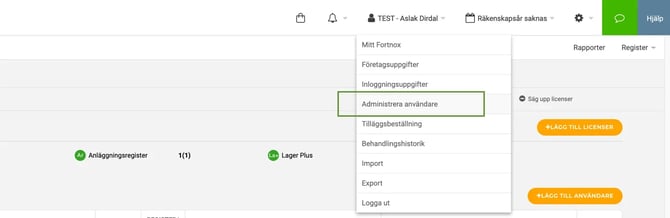
- Go to your Fortnox account
- Go to «Administrera användare» (Manage users)
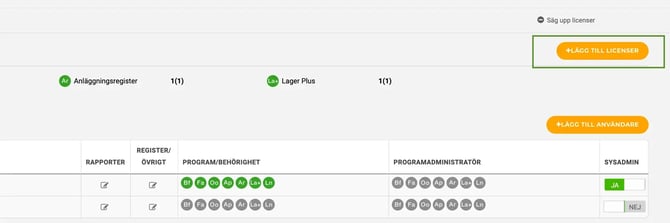
- Click «Lägg till licenser» (Add licences)
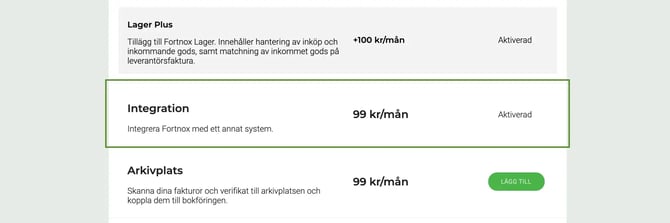
- Scroll down to «Integration: Integrera Fortnox med ett annat system» (Integrate Fortnox with another system)
- Click «Lägg till» (Add)
For questions about licences or the API in Fortnox, contact Fortnox.
2a. Connect Huma to Fortnox
To set up integrations in Huma, the user must have a «System role with full access to Organization».
- Log in to Huma, go to «Integrations» and select Fortnox
- Read all the information about the Fortnox integration before you continue.
- Click «Set up» in the top right corner
- Give the connection a name and choose who should be part of it (everyone/teams/locations/companies)
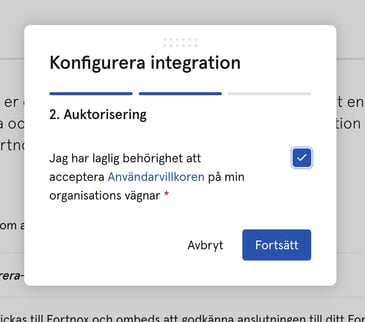
- Check «Terms of use» and click «Continue»
- Check the settings you want. Read more about the settings in the next step
- Click «Save». A window from Fortnox opens
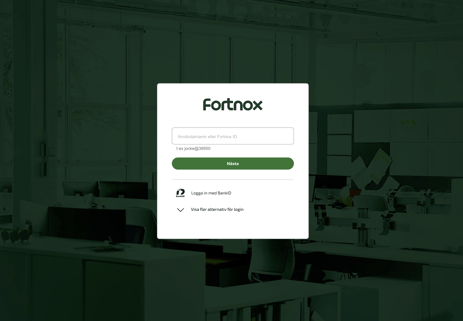
- Click «Godkänn behörighet» (Approve permission)
- The connection between the systems is now established.
2b. Configure integration settings
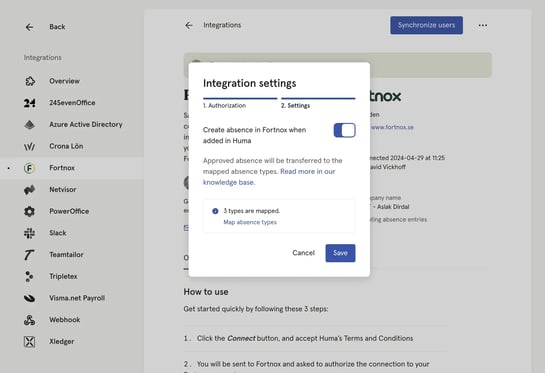
Enable «Create absence in Fortnox when added in Huma» if you want to transfer absence to Fortnox
- Absence registered and approved in Huma is transferred to Fortnox and assigned the corresponding absence type there.
- Changes to absence in Huma lead to changes in the absence created in Fortnox.
- If absence is deleted in Huma, it is also deleted in Fortnox.
- Only absence that «counts as working days» is transferred to Fortnox.
Click «Save». The connection between the systems is now established.
2c. Map absence types
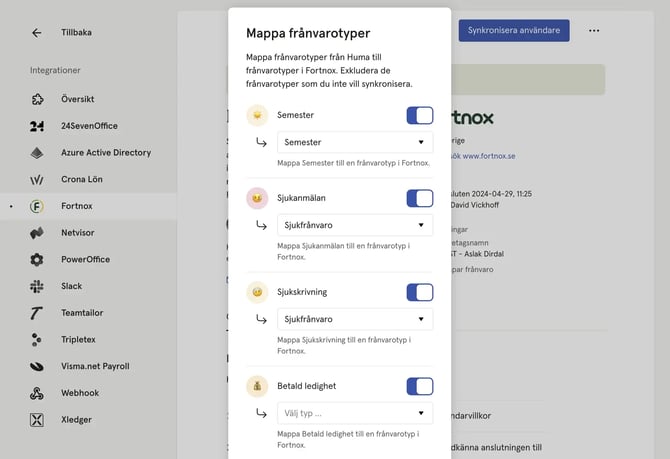
If you have chosen to sync absence from Huma to Fortnox, you must map absence types:
- Go through all absence types
- Select the corresponding absence type (activity) in Fortnox
- Exclude types you do not want to transfer
⚠️ Fortnox only has one absence type for sick leave, while Huma has both «Self-certification» and «Sick leave». We recommend mapping both to «Sjukfrånvaro» (Sick leave) in Fortnox.
💡 Read more about how absence is handled in integrations in general, and here for Fortnox.
3. Sync users and choose how to handle conflicts or missing values
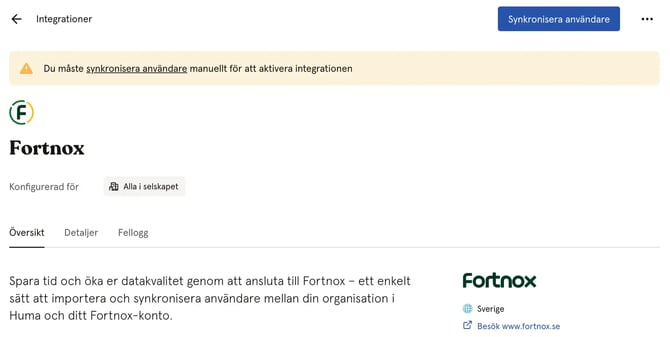
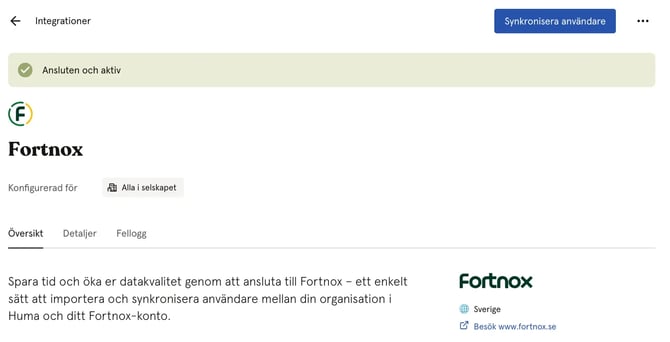
After you click «Save», you are taken to the connection's main page. To activate the integration, you must click «Sync users».
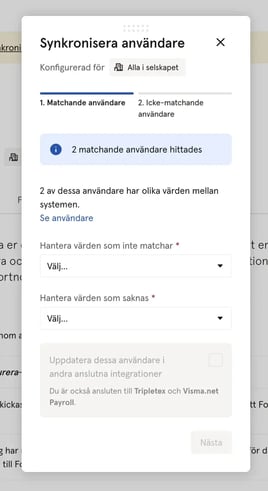
- Click «Sync users»
- Matching users: users found in both Huma and Fortnox (same email address in both systems)
- Click «View users» to see which supported fields do not match or are missing
- Handle «non-matching» or «missing values»
- Click «Next»
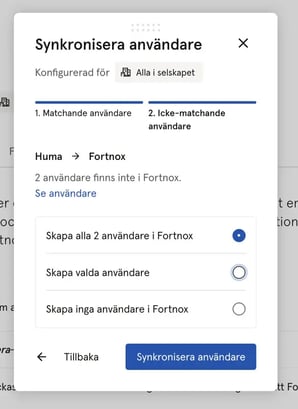
- Non-matching users: users that only exist in one of the systems
- Choose between creating «all/selected users/do not create»
- Choose how users should be created:
- Fortnox > Huma: add to Huma
- Huma > Fortnox: add to Fortnox
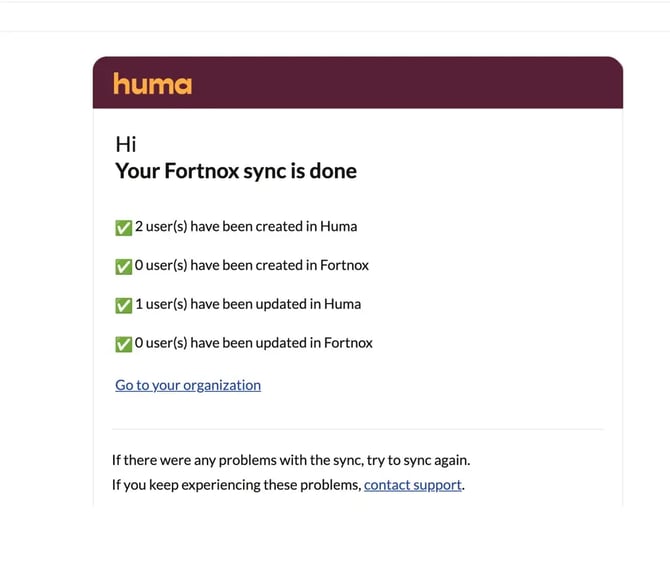
- Click «Sync users». You will receive an email with the result
⚠️ Note - Users who have not filled in all «Required fields» will not be synced.
4. Your connection between Huma and Fortnox is active
Changes to supported fields in Huma (listed below) are automatically updated in Fortnox in real time.
You need to sync users to get the latest changes from Fortnox. Changes made in Fortnox are not automatically updated in Huma.
How to sync users manually
Use «Sync users» when you have updated one of the supported fields in Fortnox, or when you want to create new users. For user sync to work, the email address must always be the same in both systems.
- Go to the Fortnox integration page in Huma
- Click «Sync users» and follow the steps. Read more about the steps here
💡 Note
- If you have created a new user in Huma, you must do a manual sync to create the user in Fortnox through the integration.
- If an error occurs during sync, you can find detailed information in the «Error log» on the Fortnox integration page in Huma.
Deactivated or deleted users
When a user is deactivated in Huma …
- the user is not deactivated in Fortnox
- the user is locked for updates
When a user is deleted in Huma …
- the user is not deleted in Fortnox
- the manual sync will ask you to create the user in Fortnox
- the user cannot be synced if changes have been made to their profile in Fortnox
Supported fields: employee fields that are synced
Changes to supported fields in Huma (listed below) are automatically updated in Fortnox in real time. Changes made in Fortnox, however, must be synced manually to Huma.
These are the profile fields synced between Huma and Fortnox:
| Huma field | Fortnox field | Notes |
|---|---|---|
| Given name | employee.firstName | |
| Family name | employee.lastName | |
| Email address* (REQUIRED) | employee.email | Must be unique. Used to identify and match users during the first user sync. |
| Phone number | employee.phone1 | If phone1 has no country code, SE is used when the number is parsed and validated. Must be unique. |
| Employment date | employee.employmentDate | |
| Employment end date | employee.employedTo | Cannot be changed in Fortnox through the integration. |
| Employee ID* (REQUIRED) | employee.employeeId | Must be unique. Only synced from Fortnox to Huma during manual user sync, not the other way. |
| Bank account number |
employee.bankAccountNo employee.clearingNo |
National: Synced from Huma if it is a Swedish bank account number.<br>International: Not supported. |
| Address |
employee.address1 employee.address2 employee.postalCode employee.city employee.country |
Supported fields: position fields that are synced
📄 Learn more about how employee data sync works in integrations in general.
⚠️ Activating the integration does not transfer historical position data to Fortnox. Only positions created or updated in Huma after the integration is activated will be synced.
💡 Position data is only synced from Huma to Fortnox, not from Fortnox to Huma.
| Huma field | Fortnox field | Notes |
|---|---|---|
| Contract start date | Employee.EmploymentDate | Uses the contract start date of the employee's earliest position in Huma. |
| Contract end date | Employee.EmployedTo | Uses the contract end date of the employee's latest position in Huma. |
Does the integration update position data?
Yes. When supported position fields are changed in Huma, the updates are sent to Fortnox automatically.
This includes changes such as updates to contract dates.
In which direction is data synced?
Position data is only synced one way:
Huma → Fortnox
Changes made directly in Fortnox are not sent back to Huma.
When is position data sent to Fortnox?
Position data is sent to Fortnox when:
- a new position is created in Huma
- an existing position is updated in Huma
- a user with a position in Huma is created in Fortnox through a manual sync
- the change happens after the integration has been activated
Can historical positions be transferred?
No. The integration does not automatically transfer historical position data that existed before the integration was activated.
Why aren't all position fields synced?
Not all position fields can be synced between Huma and Fortnox, because the two systems store and structure employment information differently. Some fields only exist in one system, or their data structures do not match directly. In other cases, limitations in the Fortnox API or in how data is handled in Huma prevent a full one-to-one mapping between the systems.
Absence sync between Fortnox and Huma
🏖️ Read more about how absence works in integrations in general.
⛓️💥 Activating the integration or turning on absence sync does not transfer historical absence records to Fortnox. Absence data is only synced to the integration when an absence has been approved in Huma. Absence sync only works from Huma to Fortnox.
Absence fields that are synced
These are the absence fields synced from Huma to Fortnox:
| Huma field | Fortnox field | Notes |
|---|---|---|
| Absence type | CauseCode | |
| Date | date | |
| Percentage | Extent | Hours are calculated based on the employee's settings in Fortnox. |
Does the integration update absence?
Yes. Huma automatically updates absence in Fortnox when it is changed (created, updated or deleted) in Huma.
What triggers calendar updates in Fortnox?
Huma automatically creates, updates or deletes time reports in Fortnox based on changes made in Huma.
When are absence entries created in Fortnox?
Only when the absence type in Huma is mapped to an activity in Fortnox and meets certain conditions, such as having an end date and being approved.
When are absence entries updated in Fortnox?
When the date, extent, note or status of an absence entry in Huma is changed after the entry has been created in Fortnox. Note that if you remove the end date of an absence, or change the status to anything other than approved, Huma will delete the absence in Fortnox.
What happens if a Fortnox mapping is changed?
If you change which Fortnox activity an absence type in Huma is mapped to, existing absence entries that Huma has already created in Fortnox for that mapping will be disconnected from the absence in Huma and will no longer be updated from Huma. However, if you edit these entries in Fortnox so their activity matches the new mapping, they will start receiving updates again.
When is an absence entry not created in Fortnox?
If the absence in Huma has no end date, or the absence request is not approved, Huma will not create an entry in Fortnox.
Due to limitations in Fortnox, Huma cannot create, edit or delete an absence period longer than 50 days in Fortnox. Changes will appear in Huma, but not in Fortnox.
How are deletions handled?
If an absence entry is deleted in Huma, Huma deletes the corresponding entry in Fortnox. Huma also deletes an entry in Fortnox if the corresponding entry in Huma loses its end date, or if an approved absence becomes unapproved.
Due to limitations in Fortnox, Huma cannot create, edit or delete an absence period longer than 50 days in Fortnox. Changes will appear in Huma, but not in Fortnox.
How does Huma match absence for updates or deletions?
Huma matches absence by employee, type and time to make sure updates or deletions in Fortnox are correct.
How are hours in calendar entries calculated?
Hours are calculated based on the employee's working time schedule, found under the «Anställning» (Employment) tab on the employee card in Fortnox.
Users created through a sync from Huma are assigned a working time schedule of 0 hours. This means all absence entries will be 0 hours.
Make sure all users have been assigned a valid working time schedule in Fortnox.
Why does Fortnox reject the request?
To avoid differences between the systems, Fortnox rejects requests with errors. All relevant users and managers receive a notification. The failed request still appears in the integration error log, so an administrator can check whether it needs to be followed up.
Make sure all users have been assigned a valid working time schedule in Fortnox.
If an absence is rejected, go to the integration page in Huma and open the «Error log» to see the error message.