Table of Contents
- What is the handbook?
- Roles and access
- How the handbook is structured
- Topics and categories
- Access and visibility
- Featured topics
- Contact persons
What is the handbook?
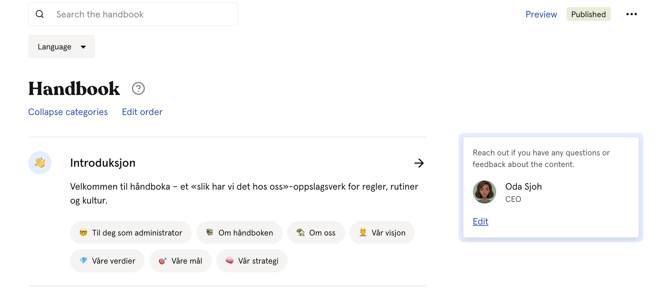
The handbook in Huma is your organisation's central hub for policies, guidelines, and other important information that employees need to know. Everything is gathered in one place, easy to search, and always up to date.
In Huma, you have one handbook. Within that handbook you can organise content into categories and topics, control who sees what, and publish content to the right people, whether that is everyone or specific groups.
Roles and access
| Access | Role |
|---|---|
| Create, edit and publish the handbook | System role: Handbook → Handbook management |
| Read published topics shared with them | All employees, no role required |
How the handbook is structured
The handbook consists of three levels:
- Handbook — the top level. There is one handbook per organisation. The handbook must be published for employees to see any content.
- Categories — used to group related topics together. A category is only visible to employees if it contains at least one published topic.
- Topics — the individual pages of content. Each topic can be set to Draft or Published, and shared with everyone or specific groups.
💡 Publishing a topic does not automatically make it visible to employees. The handbook itself must also be published. Similarly, setting a topic to "Published" only means it will be visible once the handbook is published, it does not notify employees by itself.
Topics and categories
Each topic in the handbook has the following settings:
| Setting | Description |
|---|---|
| Status | Draft or Published. Only published topics are visible to employees when the handbook is published. |
| Access | Who can see the topic — everyone, or members of specific teams, locations or companies. |
| Language | Define the language of the topic to make it easier for employees to find content in their language. |
| Tags | Used to categorise and improve searchability of topics. |
| Featured | Pin the topic to make it appear prominently in the handbook and on the dashboard. |
💡 Category summaries are not searchable. Keep them short and use them as an introduction to the topics in that category.
⚠️ A category can only be deleted if it contains no topics. Move or delete all topics in a category before deleting it.
Access and visibility
You can control who sees each topic individually. Topics can be shared with:
- Everyone — all employees in the organisation
- Members of specific groups — specific teams, locations or companies
Employees will only see the topics that have been shared with them. This means you can have topics in the same handbook that are only visible to employees in Norway, while other topics are only visible to employees in Sweden, all within the same handbook.
💡 Sharing topics with specific groups requires a Premium subscription.
Featured topics
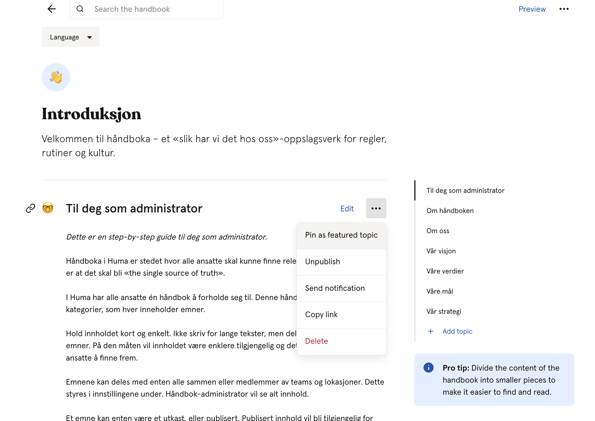
You can pin important topics to make them appear prominently both in the handbook and on the dashboard. This is useful for topics that employees frequently ask about, or content that is particularly relevant at a given time.
- Go to the Handbook module
- Click on the Category and click on the three dots on the topic you want to feature
- Click "Pin as featured topic"
💡 Only employees who have access to the topic will see it as featured on their dashboard.
💡 Featuring topics requires a Premium subscription.
Contact persons
You can add one or more contact persons to the handbook. Contact persons are displayed in the handbook so employees know who to reach out to with questions or feedback about the content.
To add or edit contact persons:
- Go to the Handbook module
- Click the three dots in the top right corner
- Click "Edit contacts"
- Add the relevant people and click "Save", or
- Click "Edit" within the contact person section (blue box)