Skip to content
  • There are no suggestions because the search field is empty.

How to work with Competence in Huma

You have full control and can add any competencies you want to track for your organization.


Table of Contents

Competence profile and GAP

General questions about competence


Competence in Huma

Competence in Huma refers to the ability to register, manage, and track a wide range of employee qualifications, including skills, languages, certifications, education, and professional experience.

Within the Huma platform, organizations can record detailed information about each employee’s competencies, upload supporting documentation, set expiration dates for certifications, and receive automated notifications when renewals are required.


The type of competence that can be registered

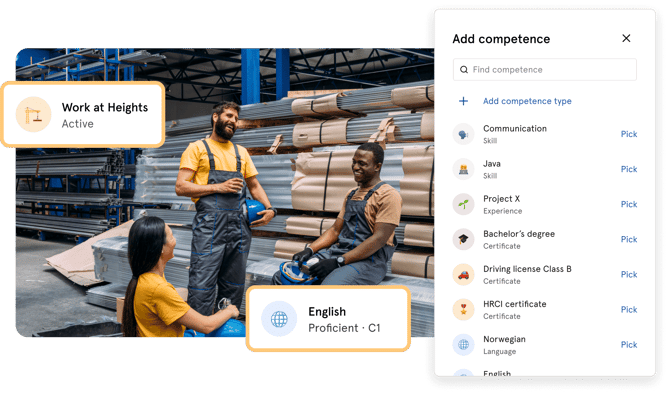
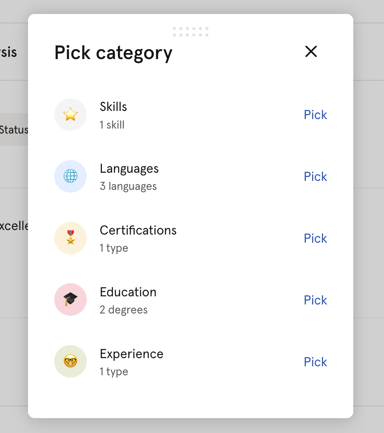
Now, with Huma, you can track a wide range of competencies, Choose between five different categories:

  1. Skills 
    Such as communication, teamwork and collaboration, problem-solving, leadership, adaptability or something else. A skill can also be other kind of knowledge such as Office 365, Photoshop, Figma, Java, HTML, SwiftUI.
  2. Language
    Such as proficiency in Norwegian, Swedish, English, and others. The language level scale is based on the Common European Framework of Reference for Languages (CEFR), an international standard for describing language ability.
  3. Certification
    This is where you’ll register your courses, HSE-certificates, driver license and more. Does the certificate have an expiry date? Perfect, we’ll let your or the administrator know when it’s time to renew/update your certificate.
  4. Education
    Choose between predefined degrees such as bachelor's, master's, or PhD degrees. You can also specify the field of study and school for reference.
  5. Experience
    Such as project or work experience.


  • The competency types cannot be edited.


Add types and define required fields

A competence type in Huma is a category used to organize and define the various qualifications, skills, certifications, languages, education, or experiences that can be assigned and tracked for employees. Examples include skills (like leadership or problem-solving), certifications (such as a license or HSE certificate), languages, educational degrees, and work experience.

To add competence type you must have a "System role with Full Access to Competence" 

  1. Go to the "Competence module"
  2. Navigate to the "All competences tab"
  3. Click "Add competence"
  4. Pick category
  5. Click "Add ...." based on the chosen category
  6. Fill out
    1. Name
    2. Description
    3. Enable "Issued date required", "Expiry date required", and/or "Documentation required" to make these fields mandatory for this competence type
  7. Click "Save"
    1. The competence type will be available for competence administrators
    2. If you want to create another type just toggle on the "Add another one"


All competences

To get a comprehensive overview of competence in Huma, navigate to the “All competences” section within the Competence module.

Here, you can view an aggregated list of all competencies registered across your organization, filtered by category, team, location, or status—such as expiring certifications or missing documentation. You can also access filtered overviews directly from an individual employee’s profile, a specific team, or a location to see relevant competencies in context.

The list of types can be filtered

  • Category: list only competency for the selected categories
  • Teams, location and companies: list only competency for members of team or location
  • Status: list only competency that has expired, expire soon, where documentation is missing or where required fields are missing.


You can click on a competency and see a list of people with this competency.

To see the competency for members of a specific team or location you can simply navigate to the team and then "Competence". All competence added to members of that team or location are listed.


How to add a competence

You need of one these roles to add competence

  • Regular employees and managers can register, update and delete competences through permissions in "User roles"

  • System administrators can, in addition, create new competence types and define required fields

 You can add employees competence either in the Competence module or on their profile

Add compentece in the "Competence module"

  1. Go to the "Competence module"
  2. Navigate to the "All competences menu"
  3. Go to “Add competence”
  4. Select category and type
  5. Pick a person 
  6. Fill out 
    1. Details - this will be different from each competence type 
    2. "Notes" - will be visible to everyone
    3. "Send notification" - notification will be sent out once the competence is registered
  7. Click "Save"
    1. The competence will appear under "All competences" and in the person’s profile
    2. If you want to create another competency just check the "Add another one" toggle


Add competence on employees profile

  1. Go to the "People module"
  2. Click on the employee you want to register competence on 
  3. Navigate to the "Competence tab" 
  4. Click "Add competence"
  5. Select category and type
  6. Pick a person 
  7. Fill out 
    1. Details - this will be different from each competence type 
    2. "Notes" - will be visible to everyone
    3. "Send notification" - notification will be sent out once the competence is registered
  8. Click "Save"
    1. The competence will appear under "All competences" and in the person’s profile
    2. If you want to create another competency just toggle on the "Add another one" 
    3. Required fields that hasn't been filled out will be highlighted with a status


Your competence and a colleagues competence

Having access to these overviews empowers both employees and managers to proactively plan learning, identify development needs, ensure compliance, and foster a culture of continuous improvement within the organization.

To view your own competence
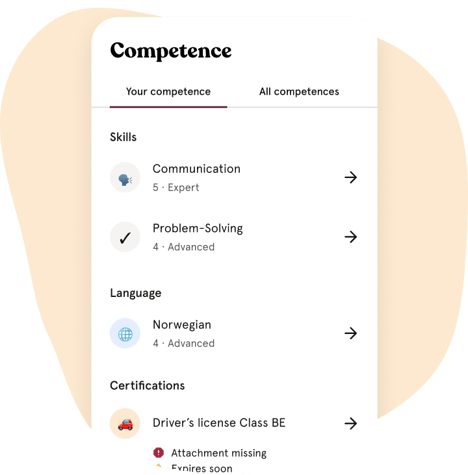
Go to the “People module” and select your profile, then navigate to the “Competence” tab.

Here you will see all competencies registered for you, organized by category. This transparent overview helps you monitor your certificates, skills, and qualifications, ensuring you remain up to date and aware of any gaps or upcoming expirations.

To view a colleague's competence
Simply open their profile and select the “Competence” tab.

You will have access to a categorized list of their registered competencies, depending on your permission level. Reviewing a colleague’s competence supports team collaboration, facilitates knowledge sharing, and helps managers allocate resources based on verified qualifications.


competence


Competence profile 

A competence profile in Huma is a detailed description of the skills, qualifications, education, certifications, and experience required for a specific role or position in the company.

The competence profile is used to:

  • Map which competencies and skills an employee or group currently has, compared to what is actually required in the role.

  • Conduct competence gap analyses, enabling the company to identify any shortcomings and implement targeted measures for competence development.

  • Give both employees and managers a clear understanding of development areas and opportunities for further training and growth.

  • Ensure that recruitment, onboarding, and training are tailored to the needs of the role and the company.

  • Increase transparency and ownership by making profiles available to employees, allowing them to see how they measure up against the requirements of the position.

In this way, competence profiles in Huma provide the company with an effective tool for strategic competence management and help employees take control of their own development.


Competence profiles can be either public or non-public. 

Public profiles are visible to all employees, promoting transparency and collaboration, while non-public profiles are restricted to competence administrators, safeguarding sensitive information where necessary.

  • Non-public profiles are only visible to competence administrators.
  • Public profiles are visible to everyone. That means you cannot restrict them to specific individuals.


Competence profile are used to find gaps within your organization, with the gap analysis.


How to find and bridge the competence gap in your organization? 

A competence profile in Huma sets the standard for necessary skills in a role. By using it for gap analysis, you can easily compare current employee competencies against these requirements, quickly revealing areas for improvement and guiding targeted training or development.

Read more about Competence Gap analysis tool here that will help you identify competence gaps within your organization.


How do I quickly get an overview of employees' various competences? 

You get a full overview in ”All competences”. Go to a colleague's profile, a team or a location to see a pre-filtered list of all associated competence.


How do I get to know that a certiciation is expired or about to expire?

You will see statuses in list and detail views that tells you whether anything needs to be updated or changed. You can also activate notifications via email and push.

If the course has an expiration date, notifications are sent 90, 30, and 2 days before the competency expires.


Who can see and open documentation?

Employees can see all details about their own competences, including files and links. Administrators with competence access can upload and open attached files, too.


Can everyone update their own competences?

Yes!

  • Employees can edit competence that is assigned to themselves. 
  • Leaders can edit competence that is assigned to themselves and their subordinates or team-members.
  • Systemadmins can edit competence on everyone and also edit competence types. 


If you want your employees to register their own competence, they must have "Full access to Competence"

  1. Go to "System settings"
  2. Navigate to "Roles"
  3. Click on "User role"
  4. Scroll down to the "Standard role for everyone"
  5. Navigate to the "On their own profile tab"
  6. Scroll down to "Competence" and set "Full access"


Can colleagues see my competence?

All employees can see each other's competencies (including skills), but not levels and certifications/documentation.

Only employees themselves and users with a system role above competence can see levels and documentation.


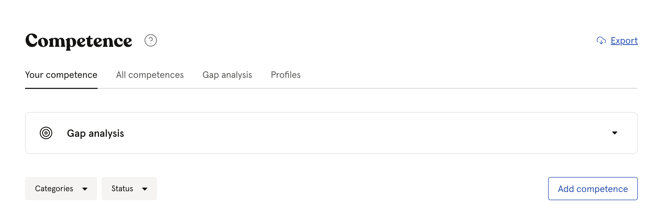
Can I export my competence data? 

Yes, you can. 

  1. Go to the "Competence module"
  2. Click "Export" in the top right corner
  3. Choose competence types and who you want to include in the export
  4. Click "Generate export"


Screenshot 2025-12-03 at 11.24.22