
Table of Contents
- Roles and access
- What is a smart document?
- What can you use smart documents for?
- Smart fields and data sources
- Store as PDF
- FAQ
Roles and access
| Access | Role |
|---|---|
| Create and edit smart documents | All employees — no role required |
| Create and manage smart document templates | System role: Documents → Smart templates and styles |
| Send documents for digital signing | System role: Documents → Digital signing |
What is a smart document?
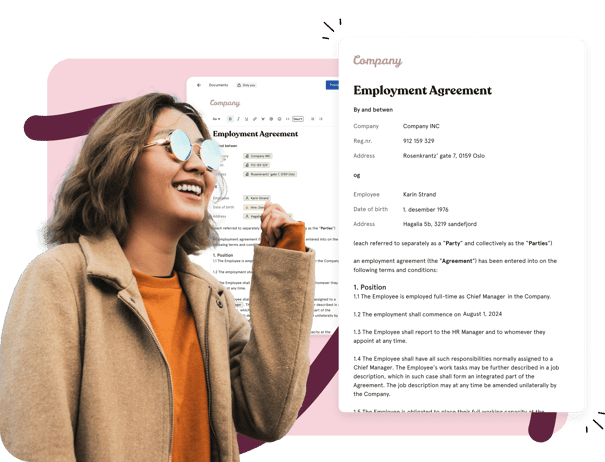
A smart document is a document created directly in Huma using a built-in editor, similar to a word processor. You can use it to write and format any type of text document, such as employment contracts, policies, meeting summaries or offer letters.
Smart documents support two ways of working:
-
As a regular word processor
You can write, format and share documents without using any advanced features. Think of it as a simpler version of Word or Google Docs, built directly into Huma. You do not need to use smart fields, data sources or templates to benefit from smart documents.
-
With smart fields and data sources
For more advanced use, you can add data sources and insert smart fields that automatically pull in data from Huma, such as an employee's name, position, salary or address. This is particularly useful for employment contracts and other documents that need to be personalised for each employee.
💡 Many organisations use smart documents simply as a word processor without ever using smart fields. You choose how advanced you want to be.
What can you use smart documents for?
Smart documents are flexible and can be used for any type of text-based HR document. Some common examples:
- Employment contracts
- Offer letters
- Policies and guidelines
- Certificates and declarations
- Meeting summaries and notes
- Salary letters
Smart fields and data sources
Smart fields are references to data in Huma that are automatically filled in when the document is opened or a PDF is generated. To use smart fields, you first need to add data sources to the document.
Data sources define what information is available in the editor. Here are some examples:
| Data source type | What becomes available |
|---|---|
| User | Contact details, employment info, salary, banking details and more for a specific person, for example "New hire" or "Supervisor" |
| Company | Company name, description, organisation number and address |
| Team | Team name and description |
| Location | Location name, description and address |
| Responsible | The person currently working on or viewing the document. When a PDF is generated or the document is sent for signing, that person's details are inserted and sealed. |
💡 In a template, smart fields show as placeholders. In a document, they show the actual value, provided the data source is assigned to a specific person and you have access to the data.
⚠️ If a smart field is not filling in correctly, check that the relevant data is entered in Huma and that you have access to it. If you do not have access to a value, replace the smart field with plain text instead.
🔗 Read more about document templates.
🔗 Read more about how to write and edit a smart document.
Store as PDF
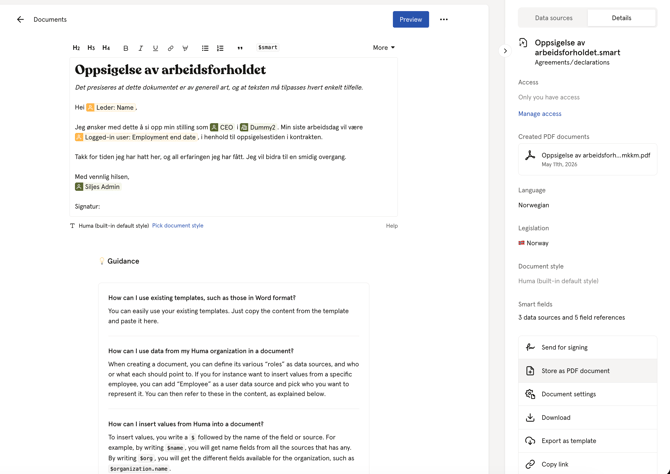
You can save a smart document as a PDF at any time. The PDF is stored as a separate document in Huma, linked to the original smart document.
-
Open the smart document
-
Navigate to "Details"
-
Click "Store as PDF document" in the right menu
-
The PDF is saved and appears in the document list
⚠️ If you update the smart document after generating a PDF, Huma will notify you that the PDF may be outdated. We recommend saving the smart document before generating a new PDF to ensure consistency.
🔗 Read more about digital signing.
FAQ
Do I need to use smart fields to use smart documents?
No. Smart documents work just like a regular word processor. You can write, format and share documents without using a single smart field.
Can I import content from a Word document?
Yes. Copy the content from your Word file and paste it into the smart editor. For best results, paste as plain text using Cmd/Ctrl + Shift + V to avoid formatting conflicts.
Can I export a smart document as a template?
Yes. Open the smart document, click the three dots in the top right corner and select "Export as template". This creates a new template based on the current document.
What happens if I update a smart document after generating a PDF?
The PDF will be marked as outdated. Generate a new PDF to get an up-to-date version.
Can I send a smart document for digital signing?
Yes, if you have the "Digital signing" system role. You can send smart documents directly for signing from within the editor.