
Table of Contents
- Roles and access
- Custom survey
- Who receives the custom survey?
- Create a custom survey
- Question types
- Publish a custom survey
- Read the results
- AI Analytics
- Pause and resume a custom survey
- Edit or delete a custom survey
- Duplicate a custom survey
- FAQ
Roles and access
| Access | Role |
|---|---|
| Create, manage and view custom surveys and results | System role: Surveys |
| Exclude or include employees from surveys | System role: Surveys or User role: Surveys — granted over the relevant groups |
Custom survey
A custom survey lets you collect feedback or input from employees on any topic you define, with your own questions and structure. While eNPS measures a single standardised metric, custom surveys give you complete flexibility.
Custom surveys are useful for a wide range of purposes, from formal HR initiatives to everyday practical needs:
- Employee engagement — pulse surveys, onboarding feedback or exit surveys
- Performance and development — gathering input before appraisals or after training
- Wellbeing — understanding how employees are feeling or what they need
- Practical input — company trips, office logistics, social events or quick polls
You can build your survey manually by adding your own questions, or let the AI help you get started by generating questions based on a description you provide.
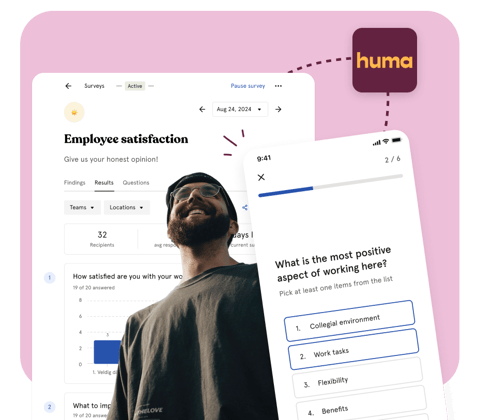
Who receives the survey?
Each time a survey run is sent, Huma checks who should receive it. Whichever recipient option you choose, an employee only receives the survey if all of the criteria below are met at that moment.
| Criterion | Description |
|---|---|
| Active user | The employee is not deactivated |
| Recipient selection | The employee is included in the recipient selection: Everyone, member of a selected group, or selected as an individual |
| Active position | The start date has passed, and the end date is empty or has not passed |
| Invited or logged in | The employee has been invited to Huma or has logged in at least once |
💡 Note
-
The recipient list is locked when the run is sent. For recurring surveys, new hires receive the survey from the next run.
-
Employees who are excluded from eNPS surveys still receive custom surveys.
-
If the survey is anonymous, it must have at least 5 recipients. Otherwise the run is not created, and you receive a notification.
Create a custom survey
- Go to the Surveys module
- Click "New survey"
- Choose "Custom survey"
- Fill in a name and optionally an icon
- Choose whether responses should be anonymous or not
- Click "Continue"
- Add your questions (see question types below)
- Click "Publish" when you are ready, or save as draft to continue later
💡 A custom survey can contain up to 100 questions with up to 100 answer options each.
⚠️ The anonymity setting cannot be changed after the survey has been published.
🤖 Use AI to get started
If you are not sure where to start, you can use the AI feature to generate questions automatically. Describe your desired survey or list your questions separated by line breaks, and the AI will structure them for you.
Question types
When building your survey, you can choose from the following question types:
| Type | Description |
|---|---|
| Text | An open-ended question where respondents write a free-text answer |
| Single select | Respondents choose one option from a list |
| Multiple select | Respondents can choose one or more options from a list — you can set a minimum and maximum number of selections |
| Scale | Respondents rate on a numeric scale |
| Boolean | A yes/no question |
| Section | A heading used to divide the survey into sections — not a question type, but useful for structuring longer surveys |
💡 You can mark individual questions as required, meaning respondents cannot submit the survey without answering them.
Publish a custom survey
After creating the survey and adding questions, you need to publish it.
Step 1 — Recipients
Choose who should receive the survey:
| Option | Description |
|---|---|
| Everyone | All employees in the organisation with an active position |
| Members of groups | Employees in specific teams, locations or companies |
| Individual people | Specific named employees |
Step 2 — Scheduling
Choose between a one-time or recurring survey:
| Setting | One-time | Recurring |
|---|---|---|
| Start date and time | ✅ | ✅ |
| Survey frequency | — | ✅ Choose from 1 week, 2 weeks, 1 month, 3 months, 6 months or 1 year |
| Response period | ✅ | ✅ Cannot be longer than the frequency |
💡 The default response period is 7 days.
Read the results
Results are displayed in real time as responses come in. For each survey run you can see results broken down per question, including:
- Charts for scale, single select, multiple select and boolean questions
- Written responses for text questions
- Response rate — how many of the recipients have responded
💡 For anonymous surveys, a minimum of 5 respondents is required before results are shown, to protect anonymity.
AI Analytics
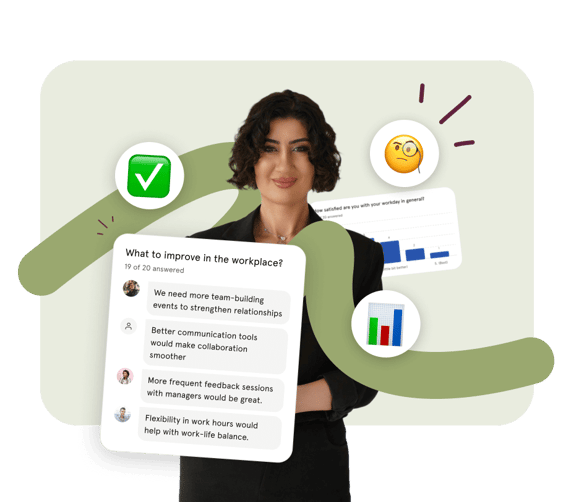
For completed survey runs with open-ended text questions, you can use AI Analytics to get an automated summary of the responses. The AI identifies key findings and provides recommendations based on the answers.
- Open a completed survey run
- Click "Analyze" to start the AI analysis
- The results show Key Findings and Recommendations based on the text responses
💡 AI Analytics is powered by OpenAI. Responses are sent to OpenAI for analysis but are not stored or used for training. The survey's anonymity settings also apply to what is sent for analysis.
🔗 Read more about security, GDPR and privacy for AI Analytics.
Pause and resume a custom survey
You can pause a recurring survey at any time. When paused:
- The current open run remains open for the rest of its response period
- All future scheduled runs are cancelled
To pause:
- Go to the Surveys module and open the survey
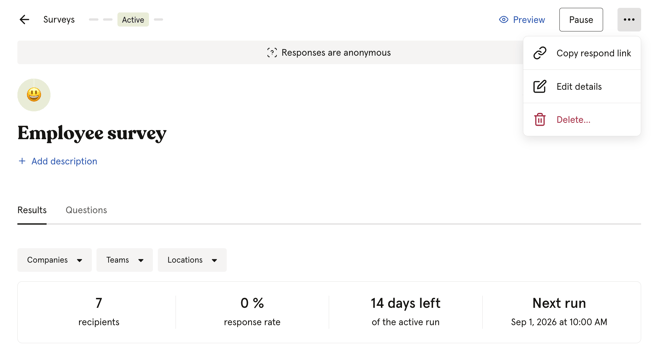
- Click the three dots in the top right corner
- Click "Pause" and confirm
- To resume, follow the same steps and click "Resume".
💡 Pausing only applies to recurring surveys. One-time surveys cannot be paused.
Edit or delete a custom survey
You can edit survey questions at any time. If the survey has already been published, changing questions will affect future runs — respondents who have already answered a previous run will see the updated questions in the next run.
To edit questions:
- Go to the Surveys module and open the survey
- Navigate to the "Questions" tab
- Make your changes
To edit survey details (name, scheduling):
- Click the three dots in the top right corner
- Click "Edit details"
To delete:
- Click the three dots in the top right corner
- Click "Delete" and confirm
⚠️ Deleting a survey permanently deletes the survey and all its runs and results. This cannot be undone.
Duplicate a custom survey
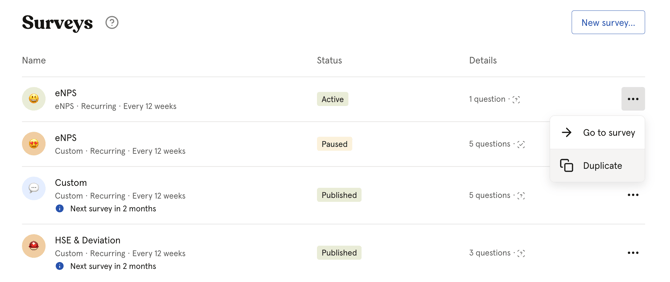
Duplicating creates a new draft survey with the same questions and settings as the original.
- Go to the Surveys module and find the survey you want to duplicate
- Click the three dots
- Click "Duplicate"
FAQ
Can I copy a respond link to share directly with recipients?
Yes. You can copy a direct respond link for the current active run by clicking "Copy respond link" in the survey. You can find this within the survey and the three dots in the top right corner. Recipients can use this link to go directly to the survey without searching for it in Huma.
Can I export survey results to Excel or CSV?
No. Huma does not currently support direct export of raw survey data. You can view and analyse results directly in Huma, or use the AI Analytics feature to get a summary of open-ended responses. If you need to save the results, you can print the results page as a PDF from your browser.
Can I change questions after the survey has been published?
Yes. You can edit questions at any time. Changes take effect from the next scheduled run, ongoing runs are not affected.
What happens if I change the anonymity setting?
The anonymity setting cannot be changed after a survey has been published. If you need to change it, you must duplicate the survey and set the correct anonymity setting before publishing the duplicate.
Can I see individual responses on a non-anonymous survey?
Yes. For non-anonymous surveys you can see which respondent submitted each answer.
Where are survey responses stored?
For detailed information about how survey responses are stored in Huma, including how anonymity is protected, see our security and privacy FAQ.
🔗 Read more about security, GDPR and privacy for surveys.