
Table of Contents
-
Supported fields - Position fields
- FAQ: Unimicro and Huma position integration
- General questions
Multiple connections
If you need to configure multiple integration instances, follow the setup guidance provided here.
Does your Unimicro account have several “Underenheter” and you need separate connections for each? Then you must configure one integration instance per “Underenhet.”
Unimicro
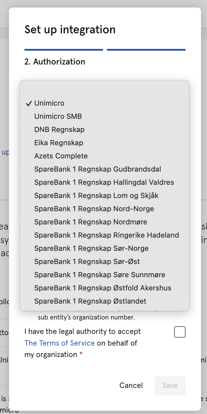
Are you using DNB Regnskap, Sparebank1 Regnskap, Eika Regnskap, or Azets? Great news: Huma now integrates seamlessly with these systems.
This means that you do not need to log in to Unimicro if you are using DNB Regnskap, Sparebank1 Regnskap, Eika Regnskap, or Azets, simply use your respective system from those listed above.
Set up the integration
-
To configure an integration in Huma, you must have a "System role with full access permissions for Organization".
-
If you are unsure which roles are required on the Unimicro side to complete the integration setup, please contact Unimicro support for guidance.
Get started quickly by following these steps:
-
Go to the integration module
- Navigate to "Unimicro," and click "New connection"
- Read "Overview" and "Details"
- Click "Set up" and fill out name and choose who should be a part of the integration
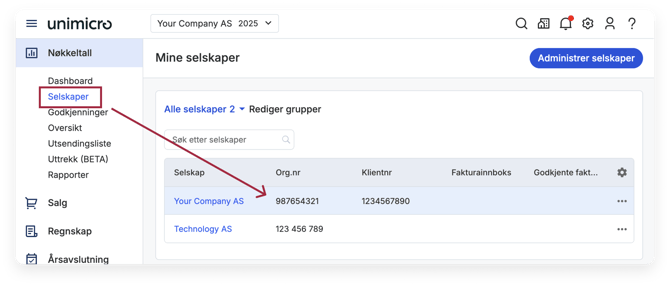
- Choose enviroment, and paste in org. number
- Toggle on/off settings for "Users," "Position," "Salary" and "Absence."
- You will be sent to Unimicro and asked to authorize the connection to your Unimicro account
- Map absence types if active
- You need to synchronize users manually to activate the integration. Click "Synchronize users."
Synchronize users between Unimicro and Huma
When synchronizing users manually, Huma will compare the users in Unimicro with users in your Huma organization. Decide what to do with non-matching and missing values, as well as with users that don’t exist in both systems.
⚠️ You need to resynchronize to add new users. They will not be added automatically
Keep profiles automatically updated from Huma to Unimicro in real-time
Changes made in the supported profile fields will be automatically updated in Unimicro.
⚠️ Note that changes made in Unimicro will not be automatically updated in Huma. To do that, you’ll need to manually synchronize once again.
Note
If an error occurs during synchronization, you can see detailed information in the “Error log” on the Unimicro- integration page in Huma.
Supported fields - Employee fields that are synchronized.
Changes made to supported fields in Huma (listed below) are automatically updated in Unimicro in real time. Changes made in Unimicro, however, must be synchronized manually in Huma.
| Huma field | Unimicro field |
|---|---|
| Email address |
Huma requires this field’s value to be unique. |
| Employment ID* (REQUIRED) |
employee.employeeNumber The integration can’t update this field’s value in Unimicro with the value in Huma. Unimicro requires this field’s value to be unique. Huma requires this field’s value to be unique. |
| Given name |
employee.businessRelation.name
|
| Family name |
employee.businessRelation.name
|
| Phone number |
employee.businessRelation.phones[].number Unimicro requires this field’s value to be unique. Huma requires this field’s value to be unique. |
| Date of birth |
birthdate
|
| Identifications |
employee.socialSecurityNumber employee.internationalID employee.internasjonalIDType employee.internasjonalIDCountry
|
| Address |
employee.addresses[].address
|
| Gender |
employee.sex Unimicro currently only supports synchronizing male and female as genders. If the gender is unspecified in Unimicro, it will remain unchanged in Huma. If the gender is custom in Huma, it will be unspecified in Unimicro. |
Supported fields - Position fields that are synchronized.
📄 Learn more about how employee data synchronization works in integrations in general.
⚠️ Note that activating the integration does not transfer historical position data to Unimicro. Only positions that are created or updated in Huma after the integration is activated will be synchronized.
Position data is synchronized only from Huma to Unimicro, not from Unimicro to Huma.
| Huma fields | Unimicro field |
| Contract type |
employee.employments[].employmentType The integration can’t set this field’s value in Unimicro with the value in Huma. Updates and deletions are supported. |
| Employment percentage |
employee.employments[].workPercent The integration can’t set this field’s value in Unimicro with the value in Huma. Updates and deletions are supported. |
| Contract start date |
employee.employments[].startDate The integration can’t set this field’s value in Unimicro with the value in Huma. Updates and deletions are supported. |
| Job title |
employee.employments[].jobName The integration can’t set this field’s value in Unimicro with the value in Huma. Updates and deletions are supported. |
FAQ: Unimicro and Huma absence integration
⛓️💥 Read more about how absence sync works in integrations in general.
💡 Note that absence sync only works from Huma to Unimicro. Absence registered directly in Unimicro is not synced back to Huma.
Supported fields — absence fields that are synced
These are the absence fields that will be synced from Huma to Unimicro:
| Huma field | Unimicro field |
| Absence type* (REQUIRED) | timeoff.code |
| Time period* (REQUIRED) | timeoff.fromDate / timeoff.toDate |
| Grade* (REQUIRED) | timeoff.extent |
| Note | timeoff.description |
How do I map absence types between Huma and Unimicro?
Go through the absence types created in Huma, and select the corresponding leave code (Timearter) in Unimicro for each of them. Correct mapping is required for sync to work and an absence type that isn't mapped will not be transferred.
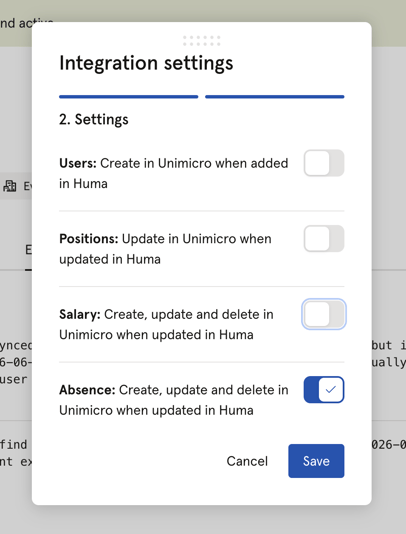
- If you already have an active integration: go to the integration page in Huma, click the three dots in the top right corner and "Edit connection settings." Toggle on for authority and click "Next," then you can toggle on absence.
- If you are setting up an integration from scratch, follow these steps.
How does absence match up between Huma and Unimicro?
Absence is matched against an employment in Unimicro if the employment period covers the absence dates. If the employee has more than one active employment covering the period, the absence is registered on all of them and not just one.
What triggers absence to be sent to Unimicro?
An absence is sent when:
- The employee is synced to Unimicro
- The absence type is mapped to a leave code in Unimicro
- At least one employment covers the absence period
- There isn't already an overlapping leave in Unimicro for the same period
What happens to absence in Unimicro when changes are made in Huma?
This depends on whether the absence type changed:
- Same type: The existing leave entry in Unimicro is updated.
- Changed type: Unimicro deletes the old entry and creates a new one. This requires both the original and the new absence type to be mapped to a leave code.
The change is applied to every employment where the original leave entry is found.
What happens if an absence is deleted in Huma?
Unimicro finds the leave entry (or entries) matching the type and date range, and deletes them, across every matching employment.
⚠️ If the absence type isn't mapped to a leave code at the time of deletion, no deletion is attempted in Unimicro, and no error is shown. Make sure the mapping stays in place if you have already-synced absence of that type.
Why are some absences rejected when registered in Huma?
Common causes:
- The absence type isn't mapped to a leave code in Unimicro
- No employment in Unimicro covers the absence period
- There's already an overlapping leave in Unimicro for the same period
For a detailed explanation, check the error log on the Unimicro integration page in Huma.
FAQ: Unimicro and Huma salary integration
💰 The integration only supports salary in NOK. Salary data in other currencies is rejected and not sent to Unimicro.
⛓️💥 Salary sync only works from Huma to Unimicro.
Supported fields — salary fields that are synced
| Huma field | Unimicro field |
|---|---|
| Start date | EmploymentSalaryHistory.FromDate |
| Salary amount* (REQUIRED) | EmploymentSalaryHistory.HourRate / YearRate / MonthRate, depending on period unit |
The period unit determines which field the amount is written to: monthly → MonthRate, yearly → YearRate, hourly → HourRate.
⚠️ Weekly salary is not supported. Unimicro has no weekly rate field, so weekly salary entries are rejected.
How do I activate salary sync for the integration?
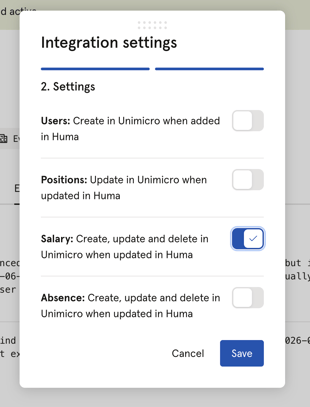
- If you already have an active integration: go to the integration page in Huma, click the three dots in the top right corner and "Edit connection settings." Toggle on for authority and click "Next," then you can toggle on salary.
- If you are setting up an integration from scratch, follow these steps.
How is salary matched to the correct employment in Unimicro?
On creation, the salary is matched to the employment whose period covers the salary's start date. If more than one employment matches, the one marked as the standard employment in Unimicro is used.
What happens if I edit or delete a salary that has no matching entry in Unimicro?
On edit or delete, Huma looks for an existing salary entry in Unimicro with the same start date as the original salary. If no matching entry is found, the change is rejected, and you'll need to apply it manually in Unimicro.
💡 Unimicro automatically sets the start date of the first salary entry to the employment's own start date, regardless of what date was set in Huma. This can cause a later edit to fail to find a match the first time, since the dates no longer line up — check directly in Unimicro if this happens.
How does the integration handle different currencies?
The integration only supports salary in NOK. Salary data in other currencies is not transferred to Unimicro, and an integration error is logged.
What happens when a salary is deleted in Huma?
The corresponding salary entry in Unimicro is deleted, provided a matching entry is found (see above).
FAQ: Huma to Unimicro position integration
Do I need to activate synchronization of position data?
Yes. We strongly recommend that you have an active integration and that synchronization of “Positions” is enabled before you start managing positions in Huma.
To do this:
-
Go to the Tripletex integration page in your Huma account
-
Click the three dots in the top-right corner and select “Edit connection settings”
-
Check the box to confirm legal authority and click “Continue”
-
Then enable “Positions: create, update and delete”
-
Positions will only be sent from Huma to Unimicro, and not from Unimicro to Huma.
- Only positions created or updated after the integration is activated will be transferred to Unimicro.
-
Create positions in Huma
You cannot create a position in Huma and have it synced to Unimicro so that it is created there. You must first create the position in Unimicro, and then create it in Huma. For the sync to work, the positions must match on the following fields:
- Contract type, Employment percentage, Contract start date and Job title.
Does the integration update position data?
Yes. When supported position fields are changed in Huma, the update is automatically sent to Unimicro.
This applies, for example, when a position is created or when fields such as contract dates, percentage of full-time equivalent, or contract type are changed.
In which direction is data synchronized?
Position data is synchronized in one direction only:
Huma → Unimicro
Changes made directly in Unimicro will not be sent back to Huma.
How are positions matched between Huma and Unimicro?
Positions are matched based on the contract start date.
-
If an existing position in Unimicro has the same start date as the position being updated in Huma, Huma will update that position in Unimicro with the new values.
-
If the start date differs, the existing position will not be updated.
This means that when you modify the first position that Huma automatically creates when Employee History is launched, you must match the start date of the position with the corresponding position in Unimicro.
When is position data sent to Unimicro?
Position data is sent to Unimicro when:
-
A new position is created in Huma
-
An existing position is updated in Huma
-
The change occurs after the integration has been activated
Can historical positions be transferred?
To register historical position data in Unimicro, this must either be done manually or by updating the position in Huma after the integration has been activated.
The integration does not transfer historical position data that existed before the integration was activated.
Why is not all position information from Huma sent to Unimicro?
Not all position fields are synchronized between Huma and Unimicro because the information stored in the two systems is structured differently. Some fields exist only in one of the systems, or they may have different structures or meanings.
In some cases, this is also due to technical limitations in the Unimicro API or in how data is handled in Huma. Because of these differences, it is not always possible to achieve a complete 1-to-1 transfer of all position fields between the systems.
Why isn’t the position removed in Unimicro when I delete it in Huma?
Unfortunately, this function is not supported, so positions must be deleted manually in Unimicro.
General Questions
How does the integration between Huma and Unimicro work?
The integration lets you sync users between Huma and Unimicro. Once connected, updates to users in Huma automatically transfer to Unimicro for supported fields. You can also run a manual sync to compare users and handle any differences.
What happens when I update a field in Huma?
If a supported field is changed in Huma, the update automatically transfers to Unimicro in real-time.
If I update a field in Unimicro, why don’t I see the change in Huma?
Changes made in Unimicro do not automatically update in Huma. To bring updates from Unimicro to Huma, you need to run a manual sync.
Why isn’t an employment relationship created when I add it in Huma?
The integration does not automatically create employment relationships in Unimicro. You need to add them manually in Unimicro.
How do I make sure employment relationship updates are reflected in Unimicro?
-
If the employee already has a default employment relationship in Unimicro, changes in Huma’s supported fields will update automatically.
-
If there’s no employment relationship, you must first create one manually in Unimicro.
-
Then, run a manual sync once to link the data. After that, future updates from Huma will transfer automatically.
Why doesn’t the employee ID update in Unimicro when I change it in Huma?
The employee ID cannot be changed via the integration because it is a unique identifier in Unimicro. If you change it in Huma, you’ll need to update it manually in Unimicro to keep everything correct.