
Table of Contents
- Roles and access
- What is an absence policy?
- Create a policy
- Policy settings
- Time period — calendar year vs rolling
- Reassignment and effective date
- View existing policies
- Edit a policy
- Archive a policy
- FAQ
Roles and access
| Access | Role |
|---|---|
| Create, edit and archive absence policies | System role: Absence → Absence management |
What is an absence policy?
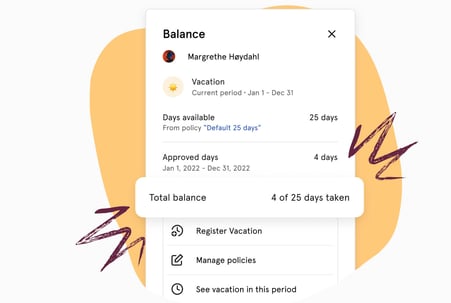
An absence policy defines the specific rules for an absence type, such as how many days employees are entitled to, whether unused days can be transferred to the next period, and whether the policy follows a calendar year or a rolling time period.
Each absence type can have multiple policies. This is useful if you have employees with different entitlements, for example employees in different countries, or employees with individual employment contracts.
💡 A policy defines how many absence days an employee is entitled to. How those days are actually counted, for example whether weekends and public holidays are included, is determined by the employee's work schedule, not the policy. Both must be set up correctly for absence to work as expected.
💡 An employee can only be assigned to one policy per absence type at a time.
🔗 Read more about how absence works in Huma.
🔗 Read more about work schedules.
Create a policy
- Go to the Absence module
- Navigate to "Settings"
- Scroll down to the relevant absence type and click on it
- Click "Add policy"
- Fill in the policy settings (see below)
- Click "Save"
💡 When you create the first policy for an absence type during the initial setup, all current employees will automatically be assigned to it. You can create additional policies and reassign employees afterwards.
Policy settings
| Setting | Description |
|---|---|
| Policy name | A descriptive name for the policy — e.g. "Standard vacation policy" or "Vacation — Norway" |
| Default for new employees | If enabled, new employees will automatically be assigned to this policy when they are added to Huma |
| Time period | Whether the policy follows a calendar year (fixed) or a rolling time period. See the section below for a detailed explanation. |
| Limit number of days | If enabled, set the number of days available per period. If disabled, employees can register unlimited absence of this type. |
| Allow days to be transferred | If enabled, unused days from one period can be carried over to the next. Note: transferring days is not possible for rolling time periods. |
| Export code | A code included in absence exports. Should match your external absence or payroll system's codes. |
| Restrictions | Only available for Self-certification. Limits how many entries employees can register and how long they can be, within the policy's time period. Can't be combined with "Limit number of days". 🔗 Read more about self-certification restrictions. |
⚠️ Once a policy has been saved, the time period and number of available days cannot be edited. To change these settings, create a new policy and reassign employees to it. Restrictions on a self-certification policy can be changed at any time.
Time period — calendar year vs rolling
The time period setting determines how absence days are counted and when the period resets.
-
Calendar year (fixed) The policy follows a fixed annual period. You choose the start date — for example January 1st or April 1st. The period always runs for exactly one year from that date.
Example: A vacation policy starting January 1st gives employees 25 days from January 1st to December 31st each year. On January 1st, the balance resets.
-
Rolling time period The policy is based on a rolling window of months back in time from today. There is no fixed reset date — the period always ends today and starts a defined number of months ago.
Example: A sick leave policy with a 12-month rolling period always counts the last 12 months from today's date.
💡 Rolling time periods are commonly used for sick leave and self-certification, where there is no fixed annual entitlement but a maximum number of days within a given period.
⚠️ Days cannot be transferred between periods on rolling time period policies.
Reassignment and effective date
When you reassign an employee from one policy to another, you can set an effective date for the change.
- Absence registered from the effective date onwards will be counted under the new policy
- Absence registered before the effective date remains in the old policy and is not affected
💡 If you leave the effective date empty, the reassignment will override all previous and future policy assignments for that employee.
⚠️ If the new policy has a different time period than the old one, any transferred days will be removed. The same applies if the new policy does not allow transfer of days.
🔗 Read more about how to assign employees to absence policies.
View existing policies
- Go to the Absence module
- Navigate to "Settings"
- Scroll down to the relevant absence type and click on it
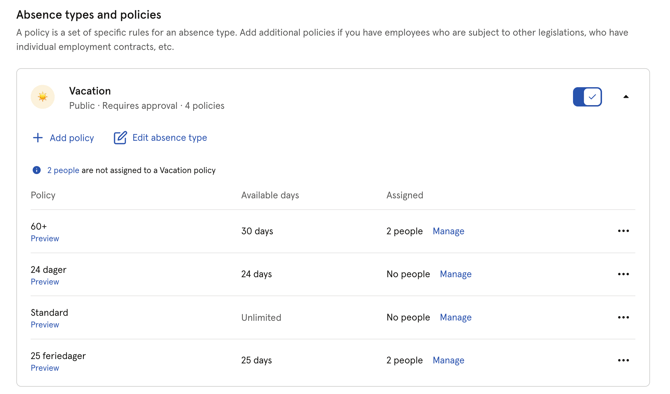
- You will see a list of all existing policies for that absence type
Edit a policy
Most policy settings can be edited after creation. However, the time period and number of available days are locked once the policy has been saved. Restrictions on a self-certification policy are not locked.
To edit other settings:
- Go to the Absence module
- Navigate to "Settings"
- Scroll down to the relevant absence type and click on it
- Click the three dots next to the policy and select "Edit"
- Make your changes and click "Save"
To change the time period or number of available days:
- Create a new policy with the correct settings
- Reassign all employees from the old policy to the new one
- Archive the old policy
Archive a policy
Archiving a policy removes it from active use. Archived policies are not deleted and historical absence data is preserved.
Before archiving, all employees must be reassigned to another policy. This includes employees who are not currently assigned but have a future policy assignment configured.
- Go to the Absence module
- Navigate to "Settings"
- Scroll down to the relevant absence type and click on it
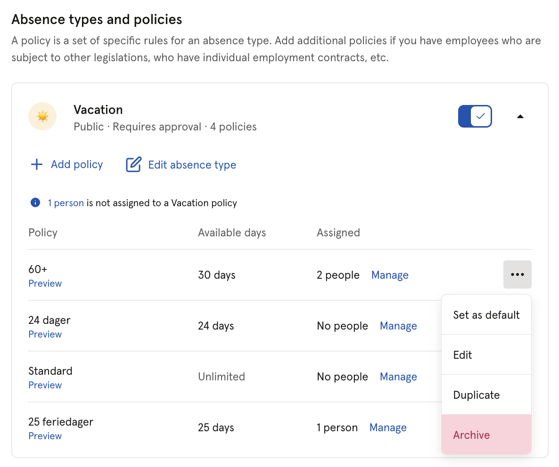
- Click the three dots next to the policy and select "Archive"
- Reassign all employees to another policy
- Confirm the archive
⚠️ You must always have at least one active policy per absence type. You cannot archive the last remaining policy.
FAQ
Can I have multiple policies for the same absence type?
Yes. You can create as many policies as you need for each absence type. This is useful if employees have different entitlements, for example based on country, seniority or individual employment contracts.
What happens to historical absence data when I archive a policy?
Historical absence data is always preserved. Archiving a policy removes it from active use, but all previously registered absence under that policy remains visible and correct in reports and exports.
What happens if an employee is not assigned to any policy?
If an employee has no policy assigned for a given absence type, they will not be able to register absence of that type. When they try, any dates not covered by a policy will be greyed out. Make sure all employees are assigned to the correct policies, especially when onboarding new employees or creating new policies.
Can I set different numbers of vacation days for different employees?
Yes. Create separate policies with different day limits and assign employees to the relevant policy. For example, you can have a "Standard vacation policy" with 25 days and a "Senior vacation policy" with 30 days.
What happens to transferred days if I reassign an employee to a new policy?
If the new policy has a different time period than the old one, or if the new policy does not allow transfer of days, any transferred days will be removed when the employee is reassigned.
Why does a new custom absence type already have a policy?
When you create a custom absence type, Huma automatically copies the default policy from its base type, if one exists — quota, time period and transfer settings included. If the base type has no default policy, the new type starts without one. Either way, no employees are assigned automatically, and the export code is not copied, so you'll still need to set an export code and assign employees before absence of that type can be registered and exported correctly.
🔗 Read more about creating custom absence types.
Can I limit how many times employees can use self-certification?
Yes. Self-certification policies can use restrictions instead of "Limit number of days". Restrictions let you set a maximum number of entries and days within the time period — for example the Norwegian 3 × 4 rule — and Huma stops registrations that go over the limits.